Today’s Dilbert:

Alice’s swearing seems to have fried the boss’s brain: the power of words.


Today’s Dilbert:
Alice’s swearing seems to have fried the boss’s brain: the power of words.
In Kevin Young’s April 12th NYT review of The Sellout by Paul Beatty, a comic novel on black life on the outskirts of Los Angeles:
There are more mentions of the N-word than on a Sigma Alpha Epsilon field trip. But like early Richard Pryor, Beatty seems to wish to take the word out of the shadows
The reclaiming of nigger is certainly of note, but this posting is about the allusion, to a Sigma Alpha Epsilon field trip. Either you get it or you don’t; it’s not something you can figure out.
Other cases, with allusions in cartoons. One case, in a Bizarro posted about here: a reference to the mummy’s cursor, which you can appreciate as a pun on the mummy’s curse without “getting” the allusion to the horror movie The Mummy’s Curse (although if you know about the movie, the cartoon is even funnier, or at least more clever). A contrasting case, in a New Yorker cartoon posted about here: a reference to a Mr. Schrödinger and his cat, which is completely baffling unless you know about the thought experiment in theoretical physics known as Schrödinger’s Cat.
Understanding the passage in Kevin Young’s NYT review similarly depends crucially on your “getting” the reference to a Sigma Alpha Epsilon field trip. For that, you need to have caught a news story last month about the SAE fraternity at the University of Oklahoma. From a 3/13 Slate piece, re-posted from Inside Higher Ed, “The Ugly, Racist, Deadly History of Sigma Alpha Epsilon” by Jake New (with the subhead “The fraternity’s problems aren’t limited to the University of Oklahoma or the South. And they stretch back decades.”). From that piece (which I recommend):
A video that surfaced online Sunday showed members of the University of Oklahoma chapter [of SAE] singing a song that has managed to both “embarrass” the fraternity and echo its segregationist roots.
“There will never be a nigger at SAE,” the students sang to the tune of “If You’re Happy and You Know It” while dressed in formal attire and riding a bus. “You can hang him from a tree, but he’ll never sign with me. There will never be a nigger at SAE.”
Hey, it was just college fun.
(Obviously heavy on taboo language, some of it about man-man sex, but no images. Use with caution.)
In mail today from TitanMen (the gay porn studio), an ad for the new video Cluster Fucked, about orgy scenes (and gangbangs). Samples on the TitanMen site for three group sex scenes, involving (for those of you who follow these things) pornstars:
Francois Sagat, Dean Flynn, Diesel Washington, CJ Madison, Brody Newport
Jason Branch, Jon Galt, Lance Gear, Nick Nicaste
Jessy Ares, Marco Wilson, Junior Stellano, Wilfried Knight
There are two senses for the noun clusterfuck or cluster fuck. From Urban Dictionary, in addition to the ‘orgy’ sense:
Military term for an operation in which multiple things have gone wrong. Related to “SNAFU” (Situation Normal, All Fucked Up”) and “FUBAR” (Fucked Up Beyond All Repair).
In radio communication or polite conversation ([e.g.,] with a very senior officer with whom you have no prior experience) the term “clusterfuck” will often be replaced by the NATO phonetic acronym “Charlie Foxtrot.”
And from the scholarly Jesse Sheidlower (3rd ed. of The F-Word), who doesn’t have Charlie Foxtrot:
Both senses have the occasional variant Mongolian clusterfuck / cluster fuck.
The connection between the two senses? One clue is that a similar ambiguity arises for circle jerk ‘group masturbation scene’, ‘mess’ and some other items. From a posting of mine on 1/3/11:
Having just posted, on my X blog, on group sex in gay porn, I’ve returned to some material on circle jerk that I started collecting in 2004
… Tom Dalzell pointed out on ADS-L that HDAS (the Historical Dictionary of American Slang) has circle jerk ‘mess’ since 1973, and the compound seemed to him to be fairly common in that sense. And Doug Wilson noted a possible parallel to cluster fuck, goat fuck, pooch screw, etc. (especially in military contexts), in which “Instead of getting their job done, the participants are engaged in undisciplined, undignified, useless activity: e.g., metaphorically, group sex or sex with animals.
Some time ago I came to consciousness in the middle of the night to intriguing music from WQXR (classical music from NYC): a collage of melodies, many hauntingly semi-familiar. Hmm, Charles Ives? Not any Ives I recognized, and quieter and less assertive than you expect from Ives. Unfamiliar and charming.
Symphony No. 50 Mount St Helens by Alan Hovhaness. And that took me to Armenians in the U.S., especially to the west of Boston (near where I lived when I was in grad school); to the Armenian diaspora; and to the genocide, a hundred years ago, that triggered the dispersal of Armenians.
The composer. From Wikipedia:
Alan Hovhaness (… March 8, 1911 – June 21, 2000) was an Armenian-American composer. He was one of the most prolific 20th-century composers, with his official catalog comprising 67 numbered symphonies (surviving manuscripts indicate over 70) and 434 opus numbers. However, the true tally is well over 500 surviving works since many opus numbers comprise two or more distinct works. [Things are more impressive than that, since Hovhaness destroyed a gigantic number of his early compositions in the face of criticisms of them.]
The Boston Globe music critic Richard Buell wrote: “Although he has been stereotyped as a self-consciously Armenian composer (rather as Ernest Bloch is seen as a Jewish composer), his output assimilates the music of many cultures. What may be most American about all of it is the way it turns its materials into a kind of exoticism. The atmosphere is hushed, reverential, mystical, nostalgic.”
He was born as Alan Vaness Chakmakjian in Somerville, Massachusetts, to Haroutioun Hovanes Chakmakjian (an Armenian chemistry professor at Tufts College who had been born in Adana, Turkey) and Madeleine Scott (an American of Scottish descent who had graduated from Wellesley College). When he was five, his family moved from Somerville to Arlington, Massachusetts. A Hovhaness family neighbor said his mother had insisted on moving from Somerville because of discrimination against Armenians there. After her death (on October 3, 1930), he began to use the surname “Hovaness” in honor of his paternal grandfather, and changed it to “Hovhaness” around 1944.
And on his 50th symphony, from the Hovhaness website:
Symphony No. 50 Mount St Helens is one of Hovhaness’s more authentically programmatic symphonies, its third movement portraying the 1980 eruption of the Washington State volcano, whose ashes settled over the Hovhaness house as they completed an entire circuit of the northern hemisphere. Both the musical discourse and sound world of the work are fairly representative of the late Hovhaness symphony: modal and strongly lyrical, alternating sections of hymnal grandeur and fugal or canonic writing, themes rarely metamorphosed in any traditional symphonic sense. Generous splashes of tintinnabulating percussion and strictly-patterned timpani writing add to the mix. The work’s dimensions are less expansive than in several other late Hovhaness symphonies, which serves to enhance its accessibility.
The opening movement is a majestic prelude and fugue suggesting the “grandeur of the mountain before [its] destruction”, while the second “Spirit Lake” movement alternates a breezy waltz with one of the best evocations of orchestral Gamelan one is likely to hear. Finally comes “Volcano”, with its music of “violence and destruction” (watch out for the bass drum thump at 1’45”) that eventually gives way to a triumphant fugue and hymn, a trademark late-period Hovhaness summing-up.
Armenian Americans. From Wikipedia:
Armenian Americans … are citizens or residents of the United States who have total or partial Armenian ancestry. They form the second largest community in the Armenian diaspora after Armenians in Russia. The first major wave of Armenian immigration to the US took place in late nineteenth and early twentieth centuries. Thousands of Armenians settled in the US following the Hamidian massacres of the mid-1890s and the Armenian Genocide of 1915 in the Ottoman Empire. Between the 1960s and 1980s Armenians from the Middle Eastern nations of Turkey, Iran and Lebanon migrated to America as a result of political instability in those countries. At around the same time immigration from Soviet Armenia began. It accelerated in the late 1980s and has continued after Armenia’s independence from the Soviet Union in 1991 due to socio-economic reasons.
… Today, estimates say that Armenians number from 50,000 to 70,000 in the Greater Boston area. The Armenian Heritage Park, dedicated to the victims of the Armenian Genocide, was opened in downtown Boston on May 22, 2012. Watertown, Massachusetts is the center of Boston Armenians, where according to estimates about 7,000 to 8,000 people of Armenian origin reside, though the 2000 Census put the number only at 2,708. The Armenian Library and Museum of America is located in Watertown. Other towns in the area with significant Armenian populations are Worcester (1,306), Belmont (1,165), Waltham (1,091) and the city of Boston (1,080).
It’s pretty clear that these Armenian communities are being diluted as people spread over the suburbs, as long-standing ethnic communities tend to do.
When I lived in Cambridge (1962-65), the Armenian communities were substantial. tightly knit, and visible. Our landlord was Armenian American, and as ethnic Americans are inclined to do, he used his compatriots for goods and services as much as possible; repair and improvement work on the apartment was done entirely by Armenian Americans (often at very odd hours, since these men had other jobs with regular hours).
For supermarket shopping, we used the Star Market in Watertown (we had marvelous, small, fancy markets close by, but for some things you want a supermarket), a nearby town which was then clearly Armenian Central for the Boston area.
The genocide. From Wikipedia:
The Armenian Genocide … also known as the Armenian Holocaust, the Armenian Massacres and, traditionally by Armenians, as Medz Yeghern … “Great Crime”), was the Ottoman government’s systematic extermination of its minority Armenian subjects inside their historic homeland, which lies within the territory constituting the present-day Republic of Turkey. The total number of people killed as a result has been estimated at between 800,000 to 1.5 million. The starting date is conventionally held to be 24 April 1915, the day Ottoman authorities rounded up and arrested, subsequently executing, some 250 Armenian intellectuals and community leaders in Constantinople.
The Turkish government is inclined to refer to the events beginning in 1915 as “violence”, maintaining that they were simply clashes between communities during wartime. I’m surprised they haven’t hit on “the late unpleasantness” as a euphemism.
Caught on tv, in the NCIS episode “Dead and Unburied” (#4.5) (2006). The team is examining a murder scene, studying the carpet intently:
Dr. Donald ‘Ducky’ Mallard [the medical examiner]: Looks like sisal. It’s a naturally stiff fiber woven from the leaf of the cactus plant. It doesn’t matt, trap dust, build static, makes it ideal for carpeting. Personally, I prefer a good shag. [Gibbs and McGee just look at him while Palmer grins like a loon]
Ducky uses the noun shag referring to a type of rug, but everyone else hears the nominalization of the verb shag ‘fuck’. Merriment ensues.
We’ve been on this scene before, in my posting “Deshagged” of 5/31/11. From that posting:
Sexual shag was for some time primarily a British usage, though the success of the Austin Powers movies — in particular, the 1999 Austin Powers: The Spy Who Shagged Me — seems to have spread it. (The movie title was controversial in the U.K., occasioning rewording, asterisking out, and other strategies to avoid shag. It also presented puzzles for translators. See the “title censorship” section of the Wikipedia entry on the film.)
“Deshagged” goes on to trace the rug noun shag from Old English (‘rough, matted hair’) to the modern usage and notes that
Quite separately, there are various verbs shag. … The development of sexual shag (v.3) is something of a mystery.
The first attestations for sexual shag ‘to copulate (with)':
1770 T. Jefferson Memorandum Bks. 27 Dec. (1997) I. 200 He had shagged his mother and begotten himself on her body. [Yes, the American Founding Father Thomas Jefferson, the principal author of the Declaration of Independence and the third president of the United States]
1788 F. Grose Classical Dict. Vulgar Tongue (ed. 2) Shag, to copulate.
The OED also notes the use of this verb “profanely in imprecations and exclamations”, essentially taking over the syntax of fuck in this domain. The dictionary’s examples: 1933 shag off! 1971 go shag 1973 shag you!
Today’s Mother Goose and Grimm:

Ralph understands what symbols are, and even that in this context only symbols that aren’t alphanumerics count, but he hasn’t figured out that obscenicons are a conventional subset of these symbols.
Background on this blog in “The obscenicons vs. the grawlixes” of 8/1/10. Obscenicons are frequently discussed (as well as used) in cartoons; among the many examples on Language Log and this blog are a Zits and a Bizarro in this posting.
A recent Language Log posting by Mark Liberman (“Vigilance – Cleanliness”) reproduced a cartoon of Captain Haddock, Hergé’s character in Tintin, exclaiming nonsensically:
 (#1)
(#1)
That’s ‘thunder of/from Brest’ (the city in Brittany) and it’s not supposed to mean anything beyond exhibiting strong emotion in the Haddockian argot.
From Wikipedia, in considerable detail:
Captain Archibald Haddock (French: Capitaine Haddock) is a fictional character in The Adventures of Tintin, the comics series by Belgian cartoonist Hergé. He is Tintin’s best friend, a seafaring Merchant Marine Captain.
… At the time of Captain Haddock’s introduction to the series in 1940, the character’s manners presented a problem to Hergé. As a sailor, Haddock would need to have a very colourful vocabulary, but Hergé could not use any swear words as he knew his audience included children. The solution reportedly came when Hergé recalled how around 1933, shortly after the Four-Power Pact had come into being, he had overheard a market trader use the word “four-power pact” as an insult. Struck by this use of an “irrelevant insult”, Hergé hit upon the solution of the Captain using strange or esoteric words that were not actually offensive, but which he would project with great anger, as if they were very strong curse words. These words ranged across a variety of subject areas, often relating to specific terms within scientific fields of study. This behaviour would in later years become one of Haddock’s defining characteristics.
The idea took form quickly; the first appearance of the Haddockian argot occurred in The Crab with the Golden Claws when the Captain storms towards a party of Berber raiders yelling expressions like “jellyfish”, “troglodyte” and “ectoplasm”.
As a result, Captain Haddock’s colourful insults began to include “bashi-bazouk”, “visigoths”, “kleptomaniac”, “sea gherkin”, “anacoluthon”, “pockmark”, “nincompoop”, “abominable snowman”, “nitwits”, “scoundrels”, “steam rollers”, “parasites”, “vegetarians”, “floundering oath”, “carpet seller”, “blundering Bazookas”, “Popinjay”, “bragger”, “pinheads”, “miserable slugs”, “ectomorph”, “maniacs”, “pickled herring”; “freshwater swabs”, “miserable molecule of mildew”, and “Fuzzy Wuzzy”, but again, nothing actually considered a swear word.
In addition to his many insults, the most famous of Haddock’s expressions relate to any of a number of permutations of two phrases: “Billions of bilious blue blistering barnacles!” (“Mille millions de mille milliards de mille sabords!”) and “Ten thousand thundering typhoons!” (“Tonnerre de Brest!”). Haddock uses these two expressions to such an extent that Abdullah actually addresses him as “Blistering Barnacles” (“Mille sabords” in the original version).
From Crab with the Golden Claws:
 (#2)
(#2)
Anacoluthon! Invertebrate! Licorice juice!
In the early days of Tintin, as here, Captain Haddock was something of an alcoholic reprobate, but he sobered up and became a dependable, if irascible, friend and companion to Tintin.
That brings us to the wonderful word réglisse ‘licorice’ — and the licorice plant. From Wikipedia:
Liquorice, or licorice, … is the root of Glycyrrhiza glabra from which a sweet flavour can be extracted. The liquorice plant is a legume native to southern Europe, India, and parts of Asia. It is not botanically related to anise, star anise, or fennel, which are sources of similar flavouring compounds.
 (#3)
(#3)
(Botanical Illustration of Glycyrrhiza glabra from Flora von Deutschland, Österreich und der Schweiz 1885)
Note the characteristic pea-like flower.
More from Wikipedia:
The word liquorice / licorice is derived (via the Old French licoresse) from the Greek γλυκύρριζα (glukurrhiza), meaning “sweet root”, from γλυκύς (glukus), “sweet” + ῥίζα (rhiza), “root”, the name provided by Dioscorides. It has been traditionally known and used as medicine in Ayurveda for rejuvenation.
… Most liquorice is used as a flavouring agent for tobacco.
… Liquorice flavour is found in a wide variety of candies or sweets [licorice sticks, for example]. In most of these candies, the taste is reinforced by aniseed oil so the actual content of liquorice is very low.
… Liquorice is also very popular in Syria and Egypt, where it is sold as a drink, in shops as well as street vendors. [Jus de réglisse!] It is used for its expectorant qualities in folk medicine in Egypt.
Some licorice sticks:
 (#4)
(#4)
[Note: the (very substantial) inventory of food postings on this blog has now been moved from my computer to public access as a Page on this blog, under Lists.]
It starts with today’s Bizarro, which turns out to have a history:
 (#1)
(#1)
The reporter challenges the presidential spokesman on the accuracy of his pronouncements, suggesting, with a euphemistic label that rhymes (in English), that it’s just bullshit.
From the GoComics site, in a 2/16/11 piece by R.C. Harvey, “Rants & Raves: The Bizarro Art of Don Piraro”, a review of Bizarro and Other Strange Manifestations of the Art of Dan Piraro, by Dan Piraro (2009):
And his political views found their way into Bizarro. But, in an attempt to be prudent, Piraro limited the frequency of his politically tinged cartoons — until the week before the 2004 election, when he ran eight political jokes in a row, after which “I endured a storm of complaints,” he said. In one cartoon slated for publication the previous summer, he showed presidential spokesman at a press conference being asked: “Is that the truth, or the ‘Manure du Jour’?” Said Piraro: “It was decided that this cartoon would be tantamount to saying the president was full of shit and would lead to cancellations, so it was never published.”
Until today.
(Side note: the cartoon in #1 has at least two of Don Piraro’s “secret symbols” (the stick of dynamite and the eyeball) — see this site — but has no number above Piraro’s signature.)
Searching on “manure du jour” brought up lots of playful uses of the expression, plus an elaborate site from the Penn State Agriculture and Environment Center on “Manure du Jour”, a weekly webinar series covering “Pennsylvania’s Best Practices on Animal Agriculture, Water Quality, and Air Quality” (including presentations on manure storage and handling).
Harvey’s piece on Piraro had a Bizarro (from 10/24/06) that I hadn’t seen before:
 (#2)
(#2)
with the evolution / Ascent of Man meme. See my 2/1/15 posting “Bizarro evolution” for a collection of other examples and links to still more — 10 in all.
A recent Cyanide & Happiness:

The fuck is offensive, but then they get down to the white supremacist tats and it’s all cool, bro.
From the Telegraph (U.K.) on 10/31/11:
Bryon Widner rejected the racist beliefs that had made him a notorious figure amongst the American extreme Right, but was struggling to readapt to society because of the web of tattoos that covered his face and neck.
… The former racist, a founder of the Vinlanders gang of skinheads in Ohio, embarked on a painful series of 25 surgeries that took 16 months and cost $32,400
Before and after:


Just added to the Pages of Linguistics Notes on this blog: one with an inventory of postings (on Language Log and this blog) about taboo vocabulary: the choice of words labeled as taboo, the open use of these words, schemes for avoiding them, etc. Can be accessed directly by clicking here, or by clicking on “Taboo vocabulary” in the list of Pages on the right side of the main page.
This new Page joins other inventories of postings on linguistic matters: on abbreviation, anaphoric islands, attachment (in parsing), danglers, Faith vs. WF, illusions, libfixes, and mishearings. More to come.
Meanwhile, I’m struggling to find a way to format some collections of my data as Linguistics Notes, so that other researchers can have access to this material (and it can be publicly updated). In particular, my file of VPE (Verb Phrase Ellipsis) examples, with an index to them; and my file of 2pbfV (two-part back-formed verb) examples, again with an index to them. Stay tuned.
From yesterday’s NYT, on the front page, an obit by the estimable Margalit Fox, “Edward Thomas, Policing Pioneer Who Wore a Burden Stoically, Dies at 95”, which raised conflicting feelings in me. Here’s the beginning, with the bits that roused me boldfaced:
When Edward Thomas joined the Houston Police Department in 1948, he could not report for work through the front door.
He could not drive a squad car, eat in the department cafeteria or arrest a white suspect.
Walking his beat, he was once disciplined for talking to a white meter maid.
Officer Thomas, who died on Monday at 95, was the first African-American to build an eminent career with the Houston Police Department, one that endured for 63 years. By the time he retired four years ago, two months shy of his 92nd birthday, he had experienced the full compass of 20th-century race relations.
His days were suffused with the pressure to perform perfectly, lest he give his white supervisors the slightest excuse to fire him — and he could be fired, he knew, for a transgression as small as not wearing a hat.
They were also suffused with the danger he faced in the field, knowing that white colleagues would not come to his aid.
In 2011, when Officer Thomas retired with the rank of senior police officer, he was “the most revered and respected officer within the Houston Police Department,” the organization said in announcing his death, at his home in Houston.
On July 27, two weeks before he died, the department renamed its headquarters in Officer Thomas’s honor.
On the one hand, you can feel pleased at how far race relations have come (though you can be sure that fellow officers referred to him as a nigger in the old days, and that some still do). On the other hand, the history is simply appalling, a tale of constant unyielding indignities.
On the upward-swinging curve, in 1976:

Expanding on the travails listed above:
On Jan. 12, 1948, the day Officer Thomas joined the force, and for years afterward, he could not attend roll call in the squad room: His attendance was taken in the hall.
He could arrest only black people. Apprehending white suspects, he could merely detain them until a white officer was dispatched to make the arrest.
He patrolled his beat — a half-dozen-mile-wide swath spanning largely black neighborhoods — twice a day, alone, on foot: The department long refused to issue him a squad car.
“He told me,” Chief McClelland said, “that the very first time he was given permission to drive a squad car, when the sergeant gave him the keys, his instructions were: ‘You better make sure that you don’t wreck it, but if you do’ — and he referred to him by the N-word — ‘you better pin your badge to the seat and don’t come back.’ ”
For years to come, to spare the car, and his job along with it, Officer Thomas drove it to his beat, parked it, locked it and, as he had before, pounded the pavement on foot.
For talking to the meter maid, who had asked him to accompany her past a line of wolf-whistling construction workers as she made her rounds, Officer Thomas was fined a day’s pay.
… To the end of his career, … Officer Thomas did not eat in the department cafeteria. If in his early years he could not set foot there, in his later ones he would not — a small, telling act of free will.
No doubt Thomas saw the job as (in some sense) a good one, providing a better salary and a better future than other jobs he might have found; you just had a swallow a lot of shit uncomplainingly.
In Today’s Zits:

I especially like the F-bomb icon.
For your use: an icon:

Yesterday’s Dilbert, one in a series on robot technology in the workplace:

… up their asses (though the pointy-haired boss doesn’t get to finish the phrase because the C.E.O. understands where he’s going and continues his own thought).
In any case, the C.E.O.’s idea is to have robots up the wazoo, both literally (up the employees’ anuses) and figuratively (to have lots and lots of them).
On the noun wazoo, from OED2:
US informal the anus. PHRASES up (or out) the wazoo very much; in great quantity; to a great degree: he’s insured out the wazoo | Jack and I have got work up the wazoo already.
This is essentially the content of the OED3 (March 2006) entry, though there’s a bit more in the OED, which notes that wazoo is used
Freq. as a (euphemistic) substitute for ass in fig. phrases, as pain in the wazoo, etc.
and gives as its earliest cite in the sense ‘the buttocks, the anus’:
1961 Calif. Pelican (Univ. Calif., Berkeley) May (back cover) Run it up yer ol’ wazoo!
and as its earliest cite in up (also out) the wazoo:
1981 Syracuse (N.Y.) Herald-Jrnl. 5 Jan. d8/3 There comes a time in performing when you just do it. You can have theory up the wazoo.
I would have thought that wazoo in up the wazoo was just another euphemistic substitute for ass — in up the ass ‘in great quantity’, which certainly occurs now. And probably it is; the difficulty is that the OED‘s entry for ass is mostly antique and lacks this use. NOAD2, which also lacks up (or out) the ass, merely mirrors the OED in this respect.
Yesterday’s morning expression on awakening (with a need to answer the call of nature) was not exactly a name, but, well, the NP the call of nature. That led to the product Serutan — that is a name — and, in another direction, to the PP against nature, which I’ll reserve for another day.
Basic dictionary work. From NOAD2:
call of nature used euphemistically to refer to a need to urinate or defecate.
and AHD5:
A need to urinate or defecate. Often used with answer: He left the room to answer the call of nature.
Idiom dictions are roughly similar, and some offer nature’s call as an alternative.
Then there’s the McGraw-Hill Dictionary. of American Idioms and Phrasal Verbs (2002):
Euph. the need to go to the lavatory. Stop the car here! I have to answer the call of nature. There was no break in the agenda, not even for the call of nature.
This is entertaining because it defines a euphemism in terms of another euphemism, go to the lavatory ‘urinate or defecate’. More on urinate or defecate in a moment.
OED3 (June 2003) takes up the idiom under the noun nature, in the subentry:
euphem. The need of the human body to defecate and urinate. Freq. in call (also †need, †work) of nature and to ease nature. [first cite a1538 Dict. Older Sc. Tongue thare nedis of natur]
So this use of nature is venerable, but euphemistic from the beginning.
Digression: The lexical field of bodily functions. English has a rich set of lexical items in this domain, involving verbs, related action nouns, and related substance nouns. Some are vulgar, a great many are euphemistic, and a very few are stylistically neutral but formal. The neutral set:
verb: urinate [or the even more formal micturate]; defecate
action noun: urination [or micturition]; defecation
substance noun: urine; feces
There are striking lexical gaps here: there is no formal standard verb that covers the territory of urinate and defecate taken together, hence urinate or defecate and defecate and urinate in the dictionary definitions above, which use a conjunction to get an expression that does cover the conceptual territory of PERFORM-BODILY-FUNCTION. And there are corresponding gaps for the action nouns and substance nouns.
As I’ve pointed out many times in LLog and here, lexical gaps are surprisingly common; languages don’t “have a word for” many categories that are certainly of sociocultural relevance, where “a word for” means ‘an ordinary-language fixed expression of some currency’ — an olfesc — with the appropriate denotation. See my discussion on LLog on 12/2/06 and briefly on this blog on 7/29/09. Instead, we see, among other things, overcoding, where there are olfescs for specific subcases, but none for the larger category — for instance, aunt and uncle, but no olfesc covering the two types of kin taken together.
The bodily-function case is a bit more complex than this. English does have olfescs for the category PERFORM-BODILY-FUNCTION, labeled by urinate and defecate taken together, but they are stylistically marked: they are all euphemisms — go to the bathroom / lavatory, use the restroom, etc. Hence the coordinate structures in most of the dictionary entries, though at least one dictionary (see above) solves the problem by using one of these euphemisms.
(For what it’s worth. NOAD2 has another candidate, but it’s marked as a technical term from physiology: eliminate ‘expel (waste matter) from the body’.)
Serutan. From Wikipedia:
Serutan was an early fiber-type laxative [psyllium] product which was widely promoted on U.S. radio and television from the 1930s through the 1960s. It was manufactured by the J. B. Williams Co., which was founded in 1885 and bought out by Nabisco in 1971.
The origin of the brand name was straightforward. The makers merely decided to spell “natures” backwards, and “Read it backwards” was the product’s advertising slogan. This was to differentiate it as being a “natural” product as opposed to laxative brands which stimulated the colon by chemical action.
The product was almost uniformly promoted on programs whose core audience was known to be considerably older than the typical television viewer. Serutan is especially associated with The Lawrence Welk Show and The Original Amateur Hour, both of which were also sponsored by J. B. Williams products Sominex, a sleeping pill and Geritol, a vitamin supplement. Serutan was the target of numerous jokes by Bob Hope and other radio comedians during the 1930s and 1940s.
Apparently, nothing is funnier than (indirect) bathroom humor combined with mockery of old people.
An old tin of Serutan and a new bottle:

For some time now, the New York Times has been reporting, in almost daily stories, on the Canadian elections, culminating in Liberal Justin Trudeau succeeding Conservative Stephen Harper as Prime Minister. Some of these stories, by Ian Austen, refer to an episode in Trudeau’s past that some have interpreted as showing that Trudeau was not mature enough to serve as his nation’s political leader. A version from yesterday, in Austen’s “Justin Trudeau, Son of a Canadian Leader, Follows His Own Path to Power”, about Trudeau’s history:
Mr. Trudeau showed a penchant for unscripted remarks that could be refreshing or embarrassing. When Prime Minister Stephen Harper announced that Canadian fighter jets would join the American-led campaign against the Islamic State militant group, Mr. Trudeau responded with a vulgar metaphor that many called juvenile.
Now, I’ve been following Canadian politics (at some distance, the way I follow American politics; it’s often a crazy, dirty business), and I recall Trudeau strongly opposing Harper’s fighter-jet proposal, but I don’t recall any “vulgar metaphor” or any outcry about one, and I can’t find any evidence of it on the net. Of course, the proudly fastidious Times wouldn’t actually cite offensive language, but Austen doesn’t even cite or link to any story in which the episode was reported in the clear, with context. So there’s no way for me to judge whether Trudeau “broke the unwritten law” (cue the Piranha Brothers) and merited opprobrium. Words of one syllable.
[Added a bit later: Ben Zimmer has now tracked down the actual quote, which is much less exciting than Austen made it out to be. More below to fold.]
[from Ben, a National Post story of 10/2/14, “Trudeau accuses Harper government of ‘trying to whip out our CF-18s and show them how big they are’ in Iraq”:
Later at the Canada 2020 conference, Jason Kenney, the federal employment minister [in the Conservative government], said he was “disturbed” by Mr. Trudeau’s wisecrack.
“To make a juvenile high-school joke about the use of the Royal Canadian Air Force in a global coalition to combat a genocidal terrorist organization says a great deal about Mr. Trudeau’s judgment,” he said.
Jason Kenney was speaking for the Conservatives and trying to belittle Trudeau in any way he could. Trudeau sniped at Harper, and Kenney (sniffily affecting to be distressed by Trudeau’s sniping) sniped back. This is what politicians do to one another. I am not impressed.]
Further back in Trudeau’s past, there was an episode of intemperate language, but in what amounted to a scrum [NOAD2: informal, chiefly Brit. a disorderly crowd of people or things: there was quite a scrum of people at the bar]. From the National Post (Canada) on 12/15/11, in “Did Justin Trudeau’s four-letter obscenity take Commons’ behaviour to new low?”:
Justin Trudeau caused uproar in the House of Commons Wednesday after he called Federal Environment Minister Peter Kent a “piece of shit” during a heated question time debate over the Kyoto Protocol.
The Liberal MP for Papineau immediately apologized, admitting he “lost his cool” after Kent questioned why NDP environment critic Megan Leslie had not attended last week’s climate change summit in South Africa.
But Mr. Trudeau was not alone as members of Parliament hurled insults and swore at each other in the final Question Period of the year.
I note in passing that male politicians are usually expected to swear in private; if they don’t, they risk being labeled as pansies (generally a bad thing in politics, because queers are “unmanly”) — but some (Mormons and evangelical Christians, in particular) are relieved of this expectation on religious grounds.
Notes on scrums. The ‘disorderly crowd’ sense is a semantic extension from the rugby usage. From Wikipedia:
A scrum (short for scrummage) is a method of restarting play in rugby that involves players packing closely together with their heads down and attempting to gain possession of the ball.
A classic rugby scrum:
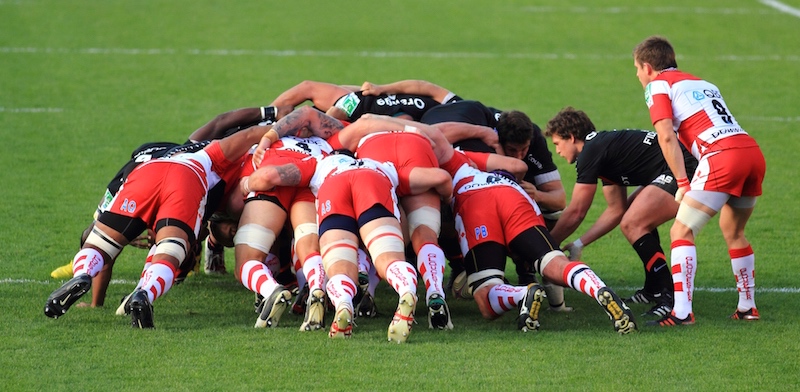 (#1)
(#1)
All that close physical contact (with no protective gear) has led many to see homoerotic content in rugby, as in this comic song from the Republic of Telly:
But, wait! There is actual gay rugby, and even an International Gay Rubgy association. (I have several friends on gay rugby teams.) Mostly they play rugby just like everybody else (but with the big plus of being able to be open about their sexuality), but they are also given to playful moments, like barebum play. Here’s a team, just hanging out, totally bare except for socks and shoes (photo passed on to me by Chris Ambidge):
 (#2)
(#2)
And another team, mostly wearing jockstraps, in a scrum:
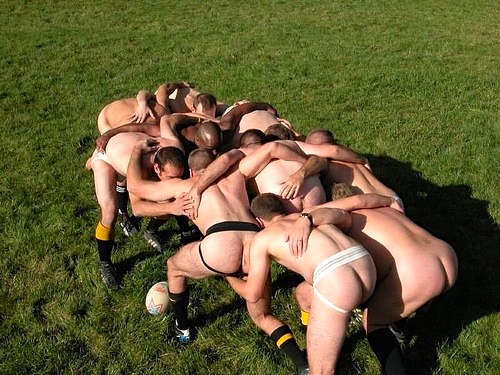 (#3)
(#3)
The chirpy and supremely annoying commercials for Dump Cakes are back on my cable tv. Here’s a sample:
The box of stuff you just dump on top of the other ingredients and bake in the oven:
 (#1)
(#1)
The name dump cake looks like a N + N compound, and not one of the possibly relevant senses of the noun dump is at all savory, and one (the sense that came first to my mind) is decidedly unsavory, on the edge of scatological taboo. Think of the idiom take a dump. How could the Dump Cakes people not have noticed this?
Lexical notes. The possibly relevant senses of the noun from NOAD2 (I put aside senses from the world of computing):
1 a site for depositing garbage.
[1a] [usu. with modifier] a place where a particular kind of waste, esp. dangerous waste, is left: a nuclear waste dump.
[1b] a heap of garbage left at a dump.
[1c] informal an unpleasant or dreary place: she says the town has become a dump.
[1d] informal an act of defecation. [the sense in take a dump]
(For what it’s worth, I’m also famiiar with a noun sense of dump as the product of defecation, that is ‘feces, turd’.)
The senses of the verb dump are not much better. The best is the one in “Just Dump & Bake!”: ‘put (something) down firmly or heavily and carelessly: she dumped her knapsack on the floor’ (NOAD2).
On the product. I turn now to a posting of 8/5/15 in Epicurious, “How to Make Dump Cake That’s Fresher, Tastier — and Just as Easy” by Katherine Sacks, which begins forthrightly:
So many delicious desserts come with beautiful names — ambrosia, ladyfingers, praline. The Dump Cake, an Internet sensation described as “so easy and very yummy,” is not one of them. In fact, it’s just the opposite: “dump cake” is by far the worst name in the history of desserts.
I’m late to the dump cake train, having only recently come across the years-old idea of “dumping” a bunch of pre-made ingredients — usually yellow cake mix and cherry pie filling — into a pan and baking it. And while I didn’t — and still don’t — understand the name, I instantly understood the appeal. People want an easy dessert. And dump cakes are as easy as dessert gets.
So recently, I dug in. Lowering myself into a dump cake wormhole on Pinterest, I found cakes made with everything from orange soda and white cake mix to chocolate cake, cherry cobbler filling, and Dr. Pepper. When I found a recipe that sounded good to me, I made it. And after a few weeks of this, I came to a conclusion:
Dump cakes deserve better.
A dump cake should yield consistent results (they usually don’t) and use real ingredients (they never do).
Sacks goes on to make a homemade dump cake with peaches, blueberries, and pecans:
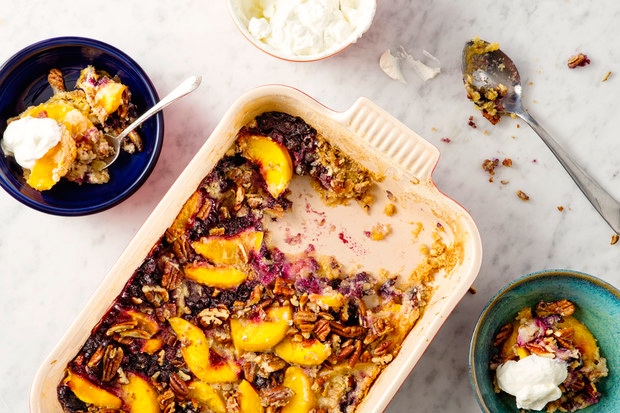 (#2)
(#2)
The quick-and-easy part of the project is creating your own homemade cake mix:
A quick whisking together of flour, sugar, baking powder, baking soda, and salt did the trick, forming a cake mix that works interchangeably with the boxed stuff, whether for dump cakes, birthday cakes, or cupcakes. Make it ahead of time, put it in a jar or bag, and keep it around for the next time you want to make any cake, dump or no.
All the rest is assembling the key central ingredients, just as in the commercial Dump Cakes approach. And using some butter. And shaking the pan during cooking. No soda pop is involved, by the way.
And you can dump the name, if you’d like. Sacks suggests thinking of things like #2 as homemade shake-‘n-bake cakes.
This Pop-Tart commercial for their new Peanut Butter & Jelly line went past me this morning:
Well, I heard the peanut of peanut butter as penis, but that’s no surprise for someone of my inclinations. I noted it, to add to my file of mishearings, but decided not to post about it; I don’t post about each instance separately. But then along came the One Million Moms and their campaign to try to force Kellogg’s to withdraw the ad, or at least edit one line they found offensive because of its “foul language”. From their 10/15 posting, “Contact Kellogg’s Concerning ‘Jam It’ Ad”:
“No! Ah, Jam It!” The advertisement could have ended with “No!” but Kellogg’s chose to include a phrase that sounded just like a curse word.
It took me a while to see that they were talking about the blasphemous profanity Damn it! / Dammit!, which for me is the mildest sort of strong language. But they’re really serious Christians, who feel that children need protection from blasphemy, or allusions to blasphemy, in the media (in expressions with words like Christ, God, damn, and hell in them — OMG!).
OMM is a project of the American Family Association. From Wikipedia:
The American Family Association (AFA) is a United States non-profit organization that promotes fundamentalist Christian values. It opposes same-sex marriage, pornography, and abortion. It also takes a position on a variety of other public policy goals and has lobbied against the Employee Free Choice Act. It was founded in 1977 by Donald Wildmon as the National Federation for Decency and is headquartered in Tupelo, Mississippi.
… AFA created One Million Moms and One Million Dads, two websites with the stated goal of mobilizing parents to “stop the exploitation of children” by the media. It uses these websites to organize boycotts and urge activists to send emails to mainstream companies employing advertising, selling products, or advertising on television shows they find offensive.
OMM is very easily offended, and rages extravagantly at the offenses it detects.
Now, about Pop-Tarts. From Wikipedia:
Pop-Tarts is a brand of rectangular, pre-baked, convenience food toaster pastries that the Kellogg Company introduced in 1964. Somewhat similar to a contemporary English mince pie tart, Pop-Tarts have a sugary filling sealed inside two layers of rectangular, thin pastry crust. Most varieties are also frosted. Although sold pre-cooked, they are designed to be warmed inside a toaster or microwave oven. They are usually sold in pairs inside foil packages, and do not require refrigeration.
… Pop-Tarts are produced in dozens of flavors, plus various one-time, seasonal, and “limited edition” flavors that appear for a short time.
Pop-Tarts are not very photogenic. But here are some S’mores Pop-Tarts:
 (#1)
(#1)
The package for one of the new PJ&B Pop-tart flavors:
 (#2)
(#2)
And a still from the commercial:
 (#3)
(#3)
A complication. For me, jam it and damn it don’t rhyme with one another — possibly a reason why I didn’t see the allusion to the curse word right off. I am one of many Philadelphia (and Philadelphia-influenced) speakers for whom so-called “short-a raising” (yielding raised, tensed variants of the phoneme /æ/ in certain phonetic contexts) applies only in certain specific words and not in others, yielding a split between a lower, lax vowel I’ll transcribe as /æ/ and a raised, tense vowel I’ll transcribe as /Æ/, with the result that the slogan “Don’t get mad, better get Glad” doesn’t rhyme: mad has /Æ/, but Glad has /æ/.
More to the current point: for me, damn has /Æ/, but jam has /æ/, so in my productions, jam it! doesn’t sound like damn it!. (In the commercial, the speaker clearly has [Æ], quite possibly because for her, short-a raising applies across the board, as it does for many Americans. A larger point here is that the relationship between a speaker’s productions and their perceptions is very complex.)
From the Washington Post on the 27th, the story “Lindsey Graham pours beers, contemplates marrying Carly Fiorina’ by David Weigel, beginning:
Boulder, Colo. — Low poll numbers almost kept him out of Wednesday’s “undercard” CNBC debate, but Sen. Lindsey O. Graham’s presidential campaign made it to Colorado — and took him into territory where few campaigns would tread. Graham (R-S.C.) was the inaugural guest at CNN’s “Politics on Tap” happy hour, its first celebrity bartender and its first participant in a twist on a somewhat salacious name game usually reserved for slumber parties.
The game has a variety of names — kill, fuck, marry; fuck, marry, kill; fuck, marry, dump; marry, fuck, kill — but all have fuck in them, and most have kill as well.
(Hat tip to Ann Burlingham.)
The WaPo story continues:
Graham, whose family owned a bar in Central, S.C., took to the evening with aplomb, posing for pictures and joking with the journalists and activists who’d RSVP’d. Egged on by CNN’s David Chalian and Dana Bash, he poured pints and shots for party attendees.
“To the Donald!” Graham said, after pouring several rounds of Jack Daniel’s and joining in a toast.
Shortly thereafter, Bash conducted an interview that veered between jokes and pathos. The altitude of the city (5,430 feet above sea level) and the potency of the spirits loosened the evening considerably; Graham, who does not typically hold his tongue, dished about diplomatic trips, mocked his 2014 primary opponents, and praised the ability of Sen. John McCain (R-Ariz.) and former secretary of state Hillary Rodham Clinton to hold their liquor.
…Bash concluded the lighthearted part of the evening with a game. “There is a fun bar game, which I will clean up, because we are in mixed company, and on television,” said Bash. “So, I’m going to call it: Date, marry, or make disappear forever.”
There were laughs and murmurs from the audience. The game Bash was referring to had an unprintable name; “make disappear forever” was a stand-in for “kill,” and “date” was taking the place of a word that, in Bash’s words, “rhymes with truck.” The choices were Hillary Clinton, Carly Fiorina, and Sarah Palin.
“You don’t want me to do the Mormon thing here,” said Graham, an apparent reference to plural marriage.
“Date, marry, or make disappear forever,” said Bash. “Take your time, senator.”
Apparently, in the classic version of the game, you are given three names of people and asked to assign the people to the choices, one to each choice; that is, you are asked to rank the three candidates, with kill for the least desirable and marry for the most. (Graham seems to know a less stringent version of the game, in which you say for each person what choice you make, leaving open the possibility of marrying more than one — or of killing more than one, or of fucking more than one.)
Graham said he would date Palin, but seemed to mean date-date, not euphemism-date; that he would marry Fiorina, because she’s rich; and he avoided answering about Clinton.
Dating as a euphemism for having sex is new to me, and the verb date as a stand-in for fuck (or screw or ball) strikes me as singularly lame euphemizing. Make disappear forever for kill is, if anything, worse: long and clunky, it doesn’t exactly trip off the tongue. Now it’s true that a fair number of verbs that might have started as euphemisms for kill have simply become slang synonyms of it and so are subject to the same anxieties about talking about death that kill might arouse: waste, off, whack, bump off, rub out. Terminate and neutralize might still count as euphemistic, but in the context of a somewhat nasty game, I can’t see any reason to avoid kill.
Today’s wry Zippy, with not much linguistic content (but it amused me):
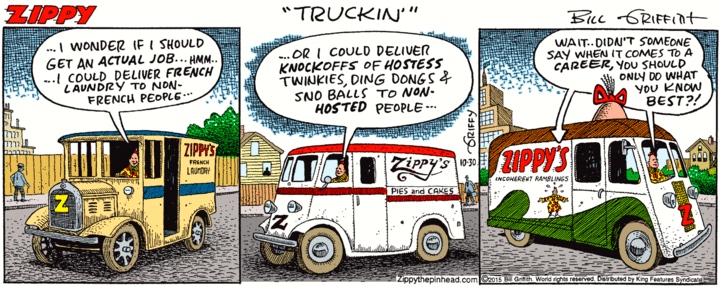
A job. With a truck. French laundry? Hostess products? Or Zippy’s home brand of incoherent ramblings (which are often not as incoherent as you might think)?
Now about the French laundry…
Getting this out of the way: Thomas Keller’s celebrated restaurant in Yountville CA is so-called because the building housed, for a time, a French steam laundry.
Putting together things from a number of sites: French laundries take special care with clothes — ironing and finishing by hand rather than machine, dealing with delicate fabrics and clothing with mixed fabrics, whitening as well as cleaning, and so on. At one time, Parisian laundry establishments were famous for these attentions to clothes, and the term French laundry came to the U.S. for places that offered such care. There used to be one just a block from my Palo Alto house, and there still is one in Menlo Park, not far from here.
In some parts of the U.S., apparently, the term French laundry has come to be used to refer to any non-Chinese laundry — as a slur on Chinese laundries, which are viewed as mechanized, careless, and cheap in the sense ‘of inferior quality’ as well as the sense of ‘inexpensive’. (Ethnic slurs on the Chinese in America have a long history, of course. On the laundry front, see my 4/23//12 posting on (among other things) “No tickee, no washee”.)
First, I note a snowclonelet composite not discussed earlier on this blog: X snob, involving a specialized use of the noun snob. Then I summarize some ADS-L discussion of possible extensions of the snowclonelet, where it was suggested that the snowclonelet might in some cases be losing its pejorative tone.
NOAD2 gives a clear delineation of snob on its own and snob as the second element of a composite nominal. First, plain old snob:
a person with an exaggerated respect for high social position or wealth who seeks to associate with social superiors and dislikes people or activities regarded as lower-class
This definition takes a negative view of a snob; it is pejorative.
Then, X snob:
[with adj. or noun modifier] a person who believes that their tastes in a particular area are superior to those of other people: a musical snob [AMZ: or a music snob]
Most examples you can collect are N + N compounds (music snob, wine snob, etc.), and the examples with adjectival first elements have pseudo-adjectives, whose semantics evokes the semantics of a noun: a musical snob is not a snob who’s musical, but a snob with resect to music. In any case, the definition is again pejorative.
Now the ADS-L discussion, which began with Benjamin Barrett reporting two finds: a customer at a coffee shop who declared herself to be a “scone snob” and a printed announcement for a professional get-together that included the words “beer snobs”. Barrett didn’t see a pejorative sense here, seeing instead a reference to someone with a discerning taste in some area or even merely being “really, really into” that area — discerning about X or merely enthusiastic about X (a development that can be seen in some other snowclonelets, which have developed an enthusiasm sense in addition to an older sexual sense: X fag, X porn, and X whore, for example; see this posting; on X porn, this one; on X whore, this one; and on X fag, this one).
Other ADS-Lers detected some pejorative tone, though now more indirect: Jon Lighter wrote on 10/26:
By adopting the well-understood pejorative term, the disdained group asserts its power.
Larry Horn, also on 10/26, re-framed this position somewhat:
I see it … as a reclamation of a slur: “Yes, I’m an X snob, and proud of it!”
Later that day, Barrett reported a Daily Mail headline (from 9/14/15) that seemed to him to lack the negative tone, but merely expressed enthusiasm:
‘My vice is that I’m a salt snob – I like gourmet, hand raked salt’: Singer Belinda Carlisle under the microscope
I’m inclined to agree with him, though neither of us can know what was in Carlisle’s head. But certainly snowclonelets can lose connotations, whether sexual or pejorative.


